History
Faculty Leader: Miss M Grant
KS3
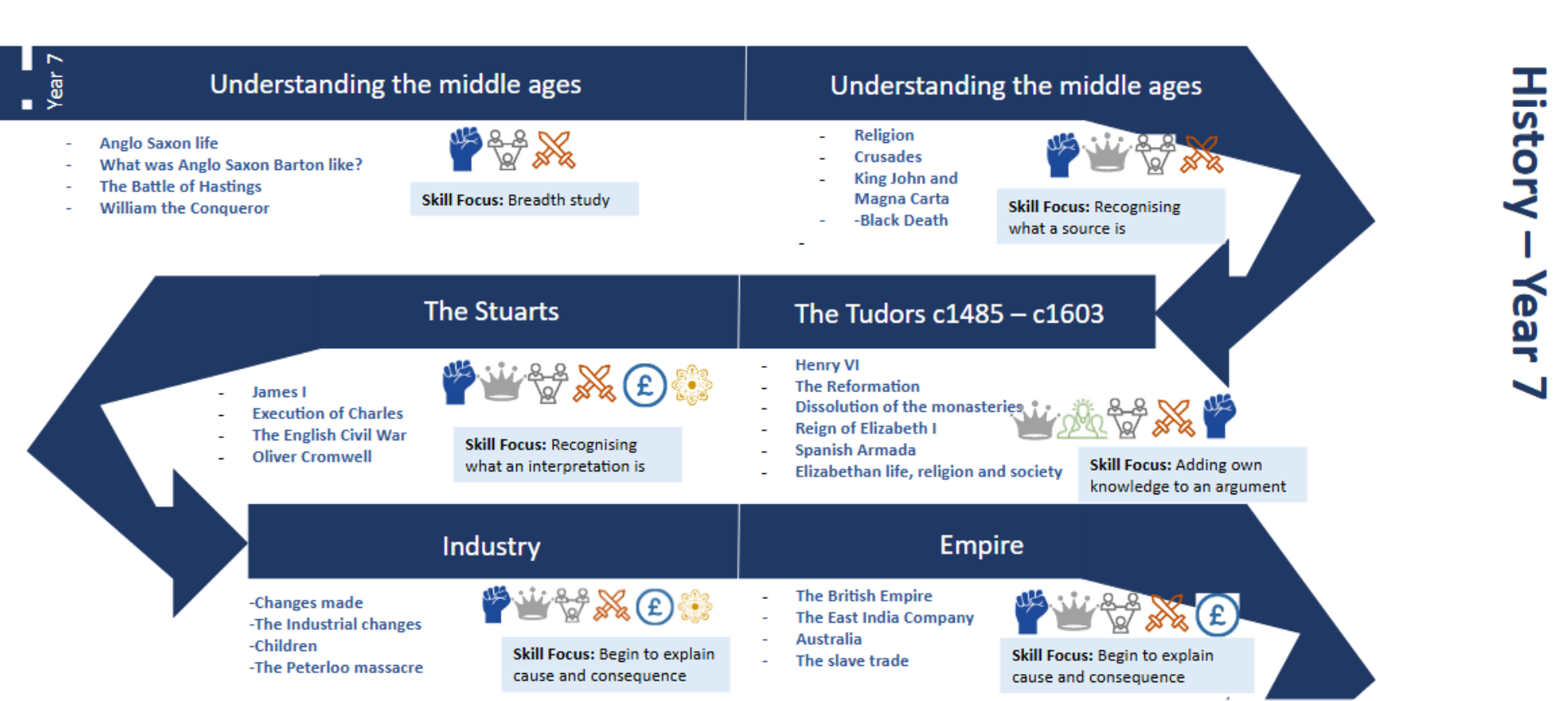
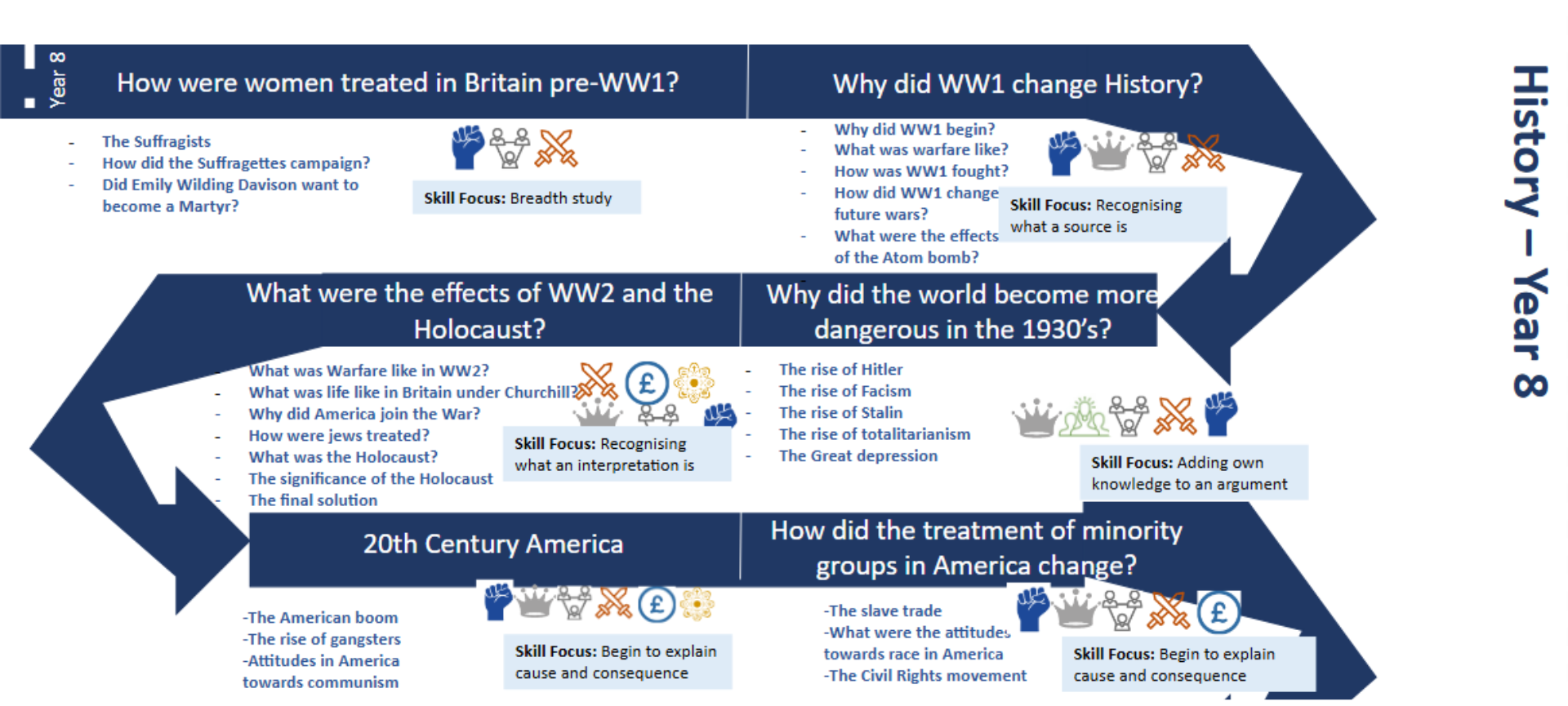
Our Key Stage 3 History curriculum delivers a chronological and thematic journey through British and world history, fully aligned with the UK National Curriculum. In Year 7, students explore British history, progressing from Anglo-Saxon migration and the Medieval era to the Tudors, Stuarts, Industrial Revolution, and the British Empire. In Year 8, the focus shifts to modern world history, covering women's suffrage, World War I, interwar dictatorships, World War II, the Holocaust, and 20th-century US history, including the Civil Rights movement.
Throughout the course, students systematically build core disciplinary skills: describing key historical features, analyzing cause and consequence, evaluating the utility of primary sources, and examining historical interpretations. Key concepts such as power, conflict, society, and minority rights run across both years. By connecting local history with global events, the curriculum equips students with deep subject knowledge and critical analytical skills.
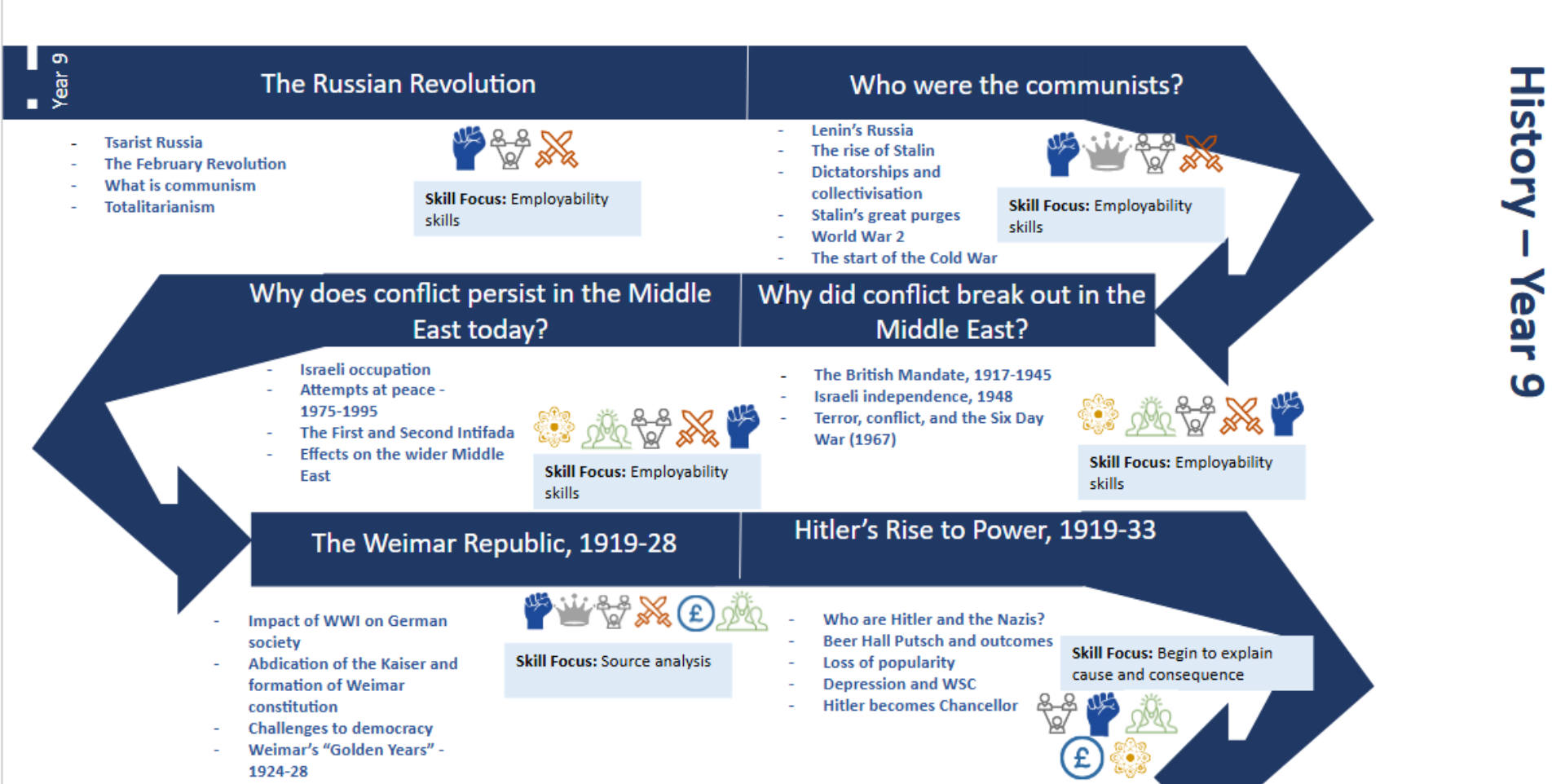
Gateway: The "Tsarist and Communist Russia" and "Conflict in the Middle East" projects build real-world job skills, teach key history ideas, and prepare students for GCSE topics.
For job skills, the Russia project teaches listening, speaking, creativity, and problem-solving through news reports, speeches, and plays. The Middle East project builds adaptability, planning, leadership, and teamwork through podcasts, group presentations, and a history exhibition.
Both projects introduce important history concepts. Students learn about political ideas like communism, capitalism, autocracy, and dictatorship, alongside how leaders control people using propaganda, censorship, and secret police. They also explore global ideas such as empire, nationalism, borders, alliances, and peacemaking.
These topics link directly to three main GCSE areas:
Cold War: Studying Russia shows how communism spread and why tensions grew between superpowers in places like Berlin. The Middle East unit shows how global powers got involved in regional conflicts.
Weimar and Nazi Germany: The Russia unit explores how dictatorships work, contrasting Stalin’s rule with Hitler’s, and covers the 1939 Nazi-Soviet Pact. The Middle East unit reinforces how propaganda and strong leaders shape nations.
Medicine and Skills: While not about medical care directly, both units build the exact skills needed for GCSE Medicine. Students practice judging historical causes, comparing viewpoints, and using graphs and statistics to analyze evidence.
KS3 Learning Journey:
KS4
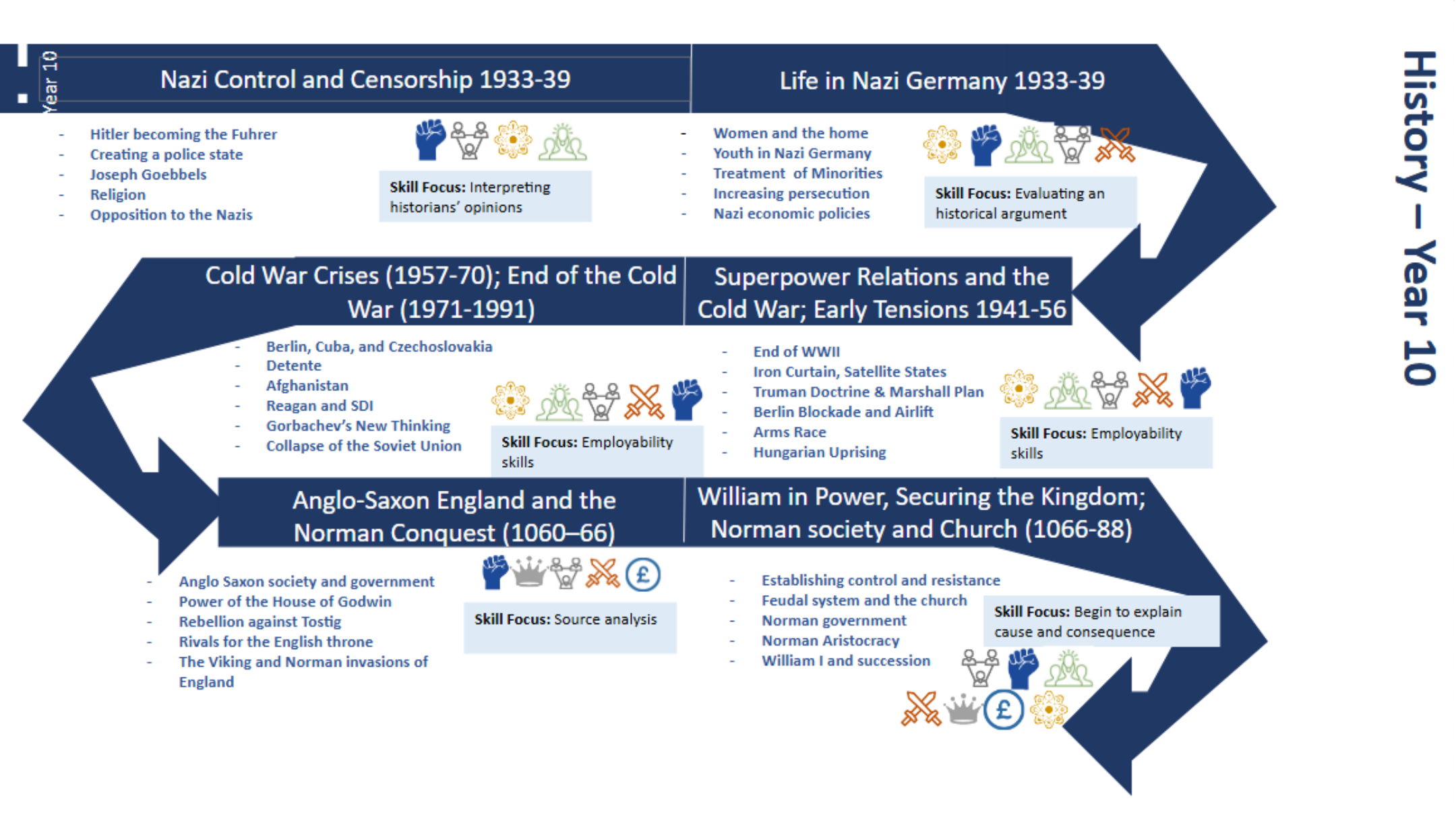
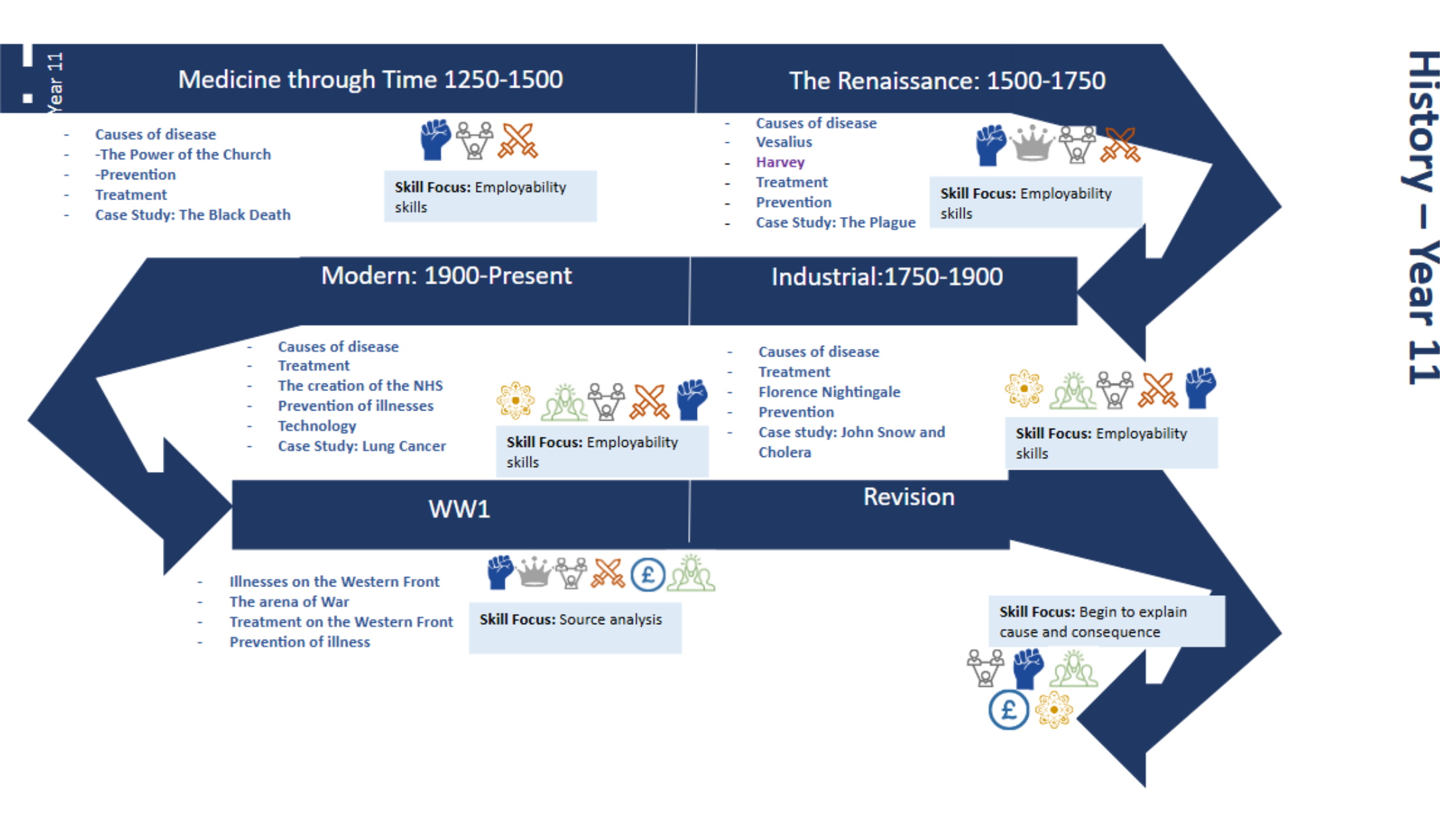
Following our Gateway topics, the Edexcel GCSE History (9-1) curriculum covers four core topics across three examination papers, combining broad thematic developments over time with deep historical investigations and global conflict analysis.
Paper 1: Medicine in Britain, c1250–present (with the Western Front, 1914–18)
This unit looks at how medical care changed over time, moving from old superstitions to modern science. Students learn about how people understood disease, prevention, and treatment across four main periods. It begins with medieval times, when people relied on religious ideas and Galen's Four Humours. It then covers the Renaissance discoveries of Vesalius and Harvey, the Industrial Revolution's breakthrough with Germ Theory, and modern advances like antibiotics, DNA, and the NHS. Students also study medicine on the Western Front during World War One, learning how trench warfare forced doctors to invent new treatments like blood transfusions. Overall, students learn to spot big changes over time and practice examining historical sources.
Paper 2: Anglo-Saxon and Norman England, c1060–88
This depth study looks at how England changed when the Normans took control. It starts with Anglo-Saxon society and the fight for the throne in 1066, leading to William the Conqueror’s victory at the Battle of Hastings. Students explore how William kept control of England by building castles, brutally crushing rebellions in the North, and recording land ownership in the Domesday Book. The course also examines changes to the English Church, law, and daily life under Norman rule. Through this topic, students learn how rulers gain and hold onto power, and how to explain the causes and results of key historical events.
Superpower Relations and the Cold War, 1941–91
This topic explores fifty years of rivalry and tension between the two global superpowers: the USA and the Soviet Union. Students study how their alliance fell apart after World War Two, leading to dangerous crises like the Berlin Blockade, the building of the Berlin Wall, and the Cuban Missile Crisis. The course finishes by looking at how high-stakes politics and economic problems led to the fall of the Berlin Wall and the collapse of the Soviet Union in 1991. By studying the Cold War, students learn how different political beliefs create conflict and how to trace long chains of cause and effect in world history.
Paper 3: Weimar and Nazi Germany, 1918–39
This topic studies how Germany changed from a new democracy into a strict dictatorship. Students look at the problems faced by the Weimar Republic after World War One, such as rebellions, economic crisis, and extreme inflation. They then study how the Great Depression helped Adolf Hitler and the Nazi Party gain support and take power in 1933. The unit covers how the Nazis removed democracy using police terror, propaganda, and censorship, and how life changed for women, young people, and workers. It also looks at the persecution of minority groups, especially Jewish people. Students learn how to compare different historical viewpoints and weigh up conflicting arguments.
KS4 Learning Journey: