Design & Technology
Faculty Leader: Mr B Wilson
KS3 Overview

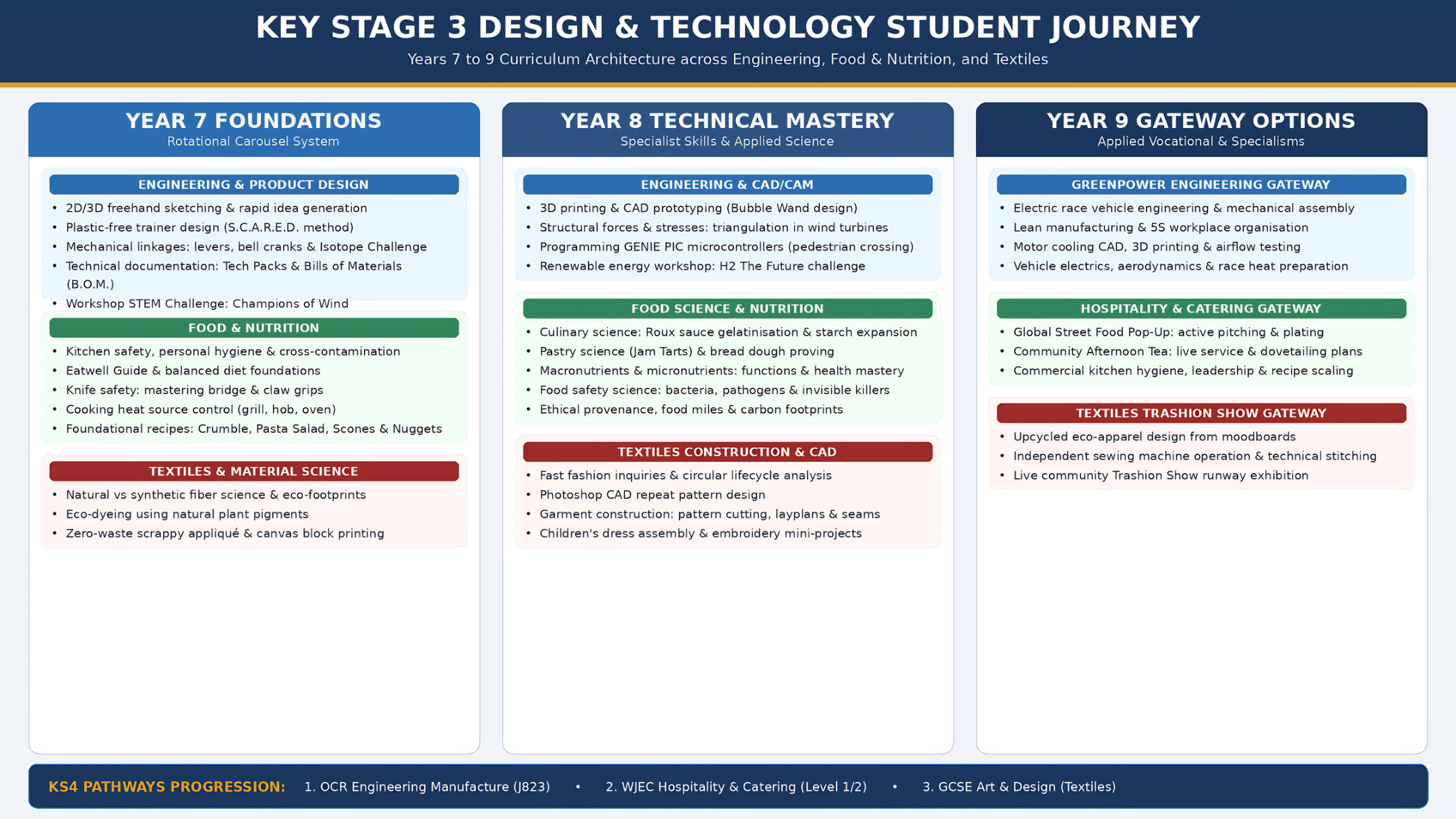
The Key Stage 3 Design & Technology curriculum at Baysgarth is designed to give all students a comprehensive understanding of the 21st-century world of design, manufacturing, and service industries
Delivered through a progressive 5-year spiral curriculum, learning reflects the real-world iterative process, building specialist skills, knowledge, and practical control year after year so that students can work with increasing independence and confidence.
The curriculum extends beyond standard specifications to equip learners with transferable life skills, an awareness of sustainable lifestyles, and a clear insight into local, national, and global career opportunities through industry links and enrichment.
Grounded in an inclusive environment, every student is supported to overcome barriers, celebrate diversity, and view themselves as creative problem solvers.
KS4 Overview
Hospitality and Catering:
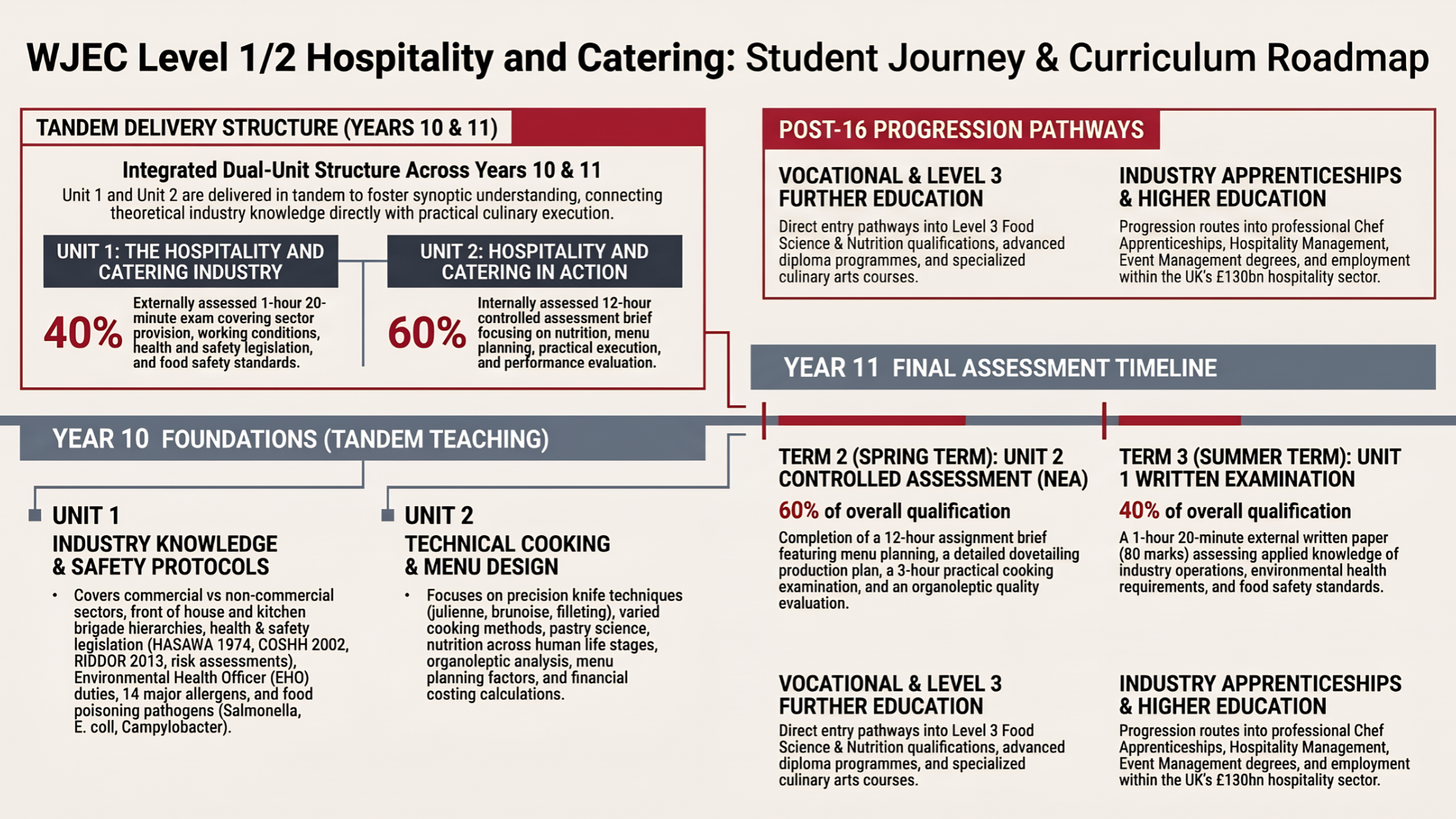
KS4: WJEC Level 1/2 Vocational Award in Hospitality and Catering (Technical Award)
At KS4, the curriculum transitions from guided cooking into an applied, industry-standard experience that prepares students for the dynamic hospitality sector. The qualification is structured into two complementary units:
Unit 1: The Hospitality and Catering Industry (External Exam, 40%): Students gain a thorough understanding of commercial and non-commercial hospitality provision, front- and back-of-house operations, job roles, working conditions, and commercial success factors. Crucially, learners master workplace health and safety regulations (COSHH, RIDDOR), food safety management systems (HACCP), and the legal responsibilities of the Environmental Health Officer (EHO).
Unit 2: Hospitality and Catering in Action (Internal Controlled Assessment, 60%): Centred on a 12-hour practical assignment, students apply nutritional knowledge to plan balanced menus for specific life-stages and dietary needs. Learners refine knife techniques and cooking methods (boiling, roasting, baking, steaming, poaching, and frying) to prepare, cook, and present high-quality dishes, concluding with self-evaluation of organoleptic qualities and waste management.
This course balances culinary art with scientific rigour, empowering students for further vocational study, college courses, or direct entry into catering and food technology pathways.
Engineering:
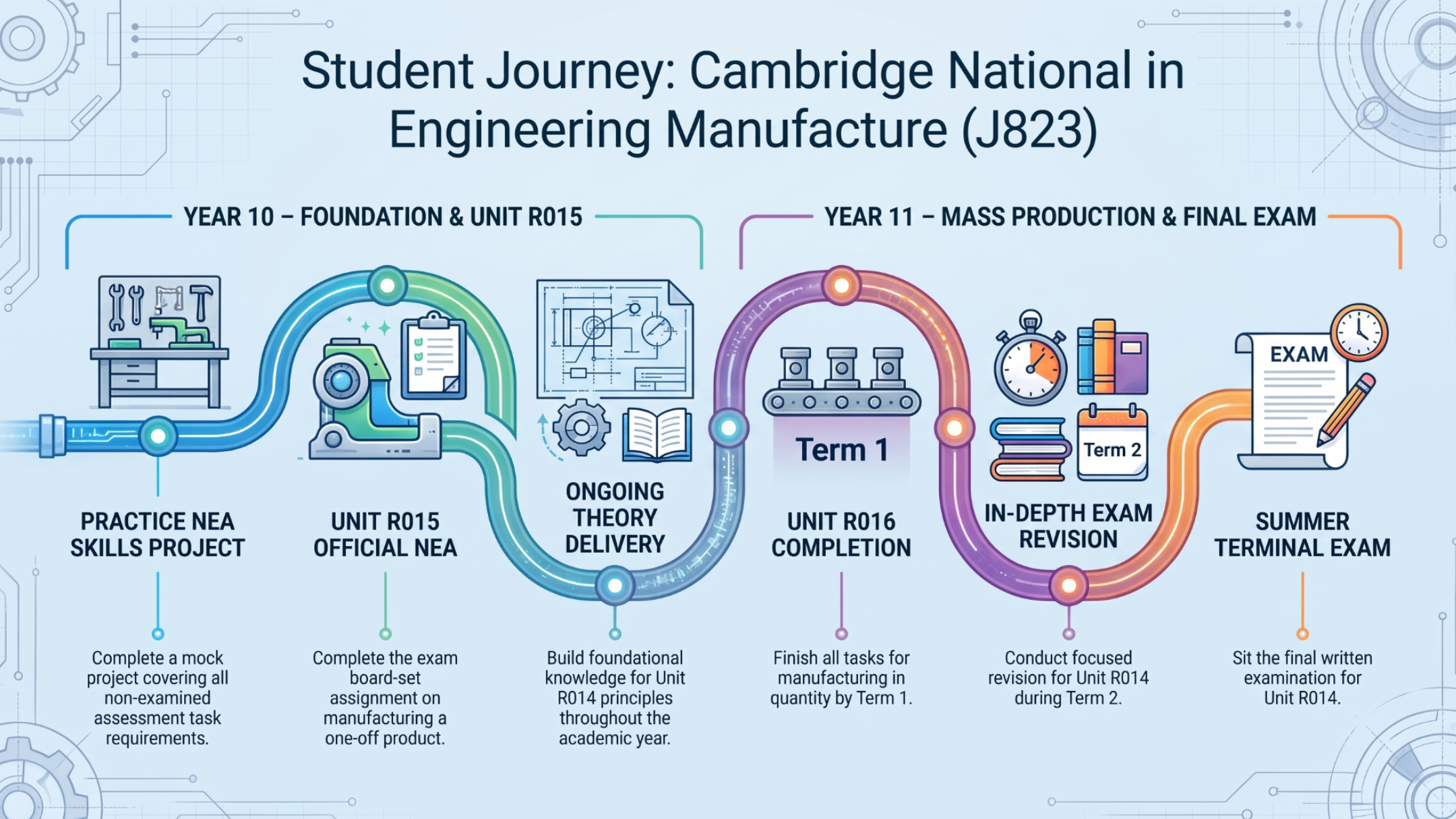
KS4: OCR Level 1/Level 2 Cambridge National in Engineering Manufacture (J823)
Building seamlessly on KS3, the KS4 Engineering curriculum provides an immersive, industry-aligned pathway where students turn concepts into high-precision physical products. The course combines theoretical knowledge with rigorous practical application across three mandatory units:
Principles of Engineering Manufacture (R014 - External Exam, 40%): Students explore fundamental manufacturing processes (wasting, shaping, forming, additive manufacturing, joining, and finishing), mechanical and physical properties of engineering materials (ferrous and non-ferrous metals, polymers, and smart materials), third-angle orthographic projection drawings, quality control/assurance, and modern industrial practices such as Just-In-Time (JIT) and Lean manufacturing.
Manufacturing a One-Off Product (R015 - Controlled Assessment, 30%): Learners interpret engineering drawings, plan production sequences, conduct risk assessments, and use manual tools and machining processes to safely fabricate a prototype or one-off component.
Manufacturing in Quantity (R016 - Controlled Assessment, 30%): Students leverage CAD/CAM technology and program Computer Numerical Control (CNC) machinery to manufacture precision products in quantity to commercial standards.
This qualification equips students with transferable problem-solving and planning skills, opening direct progression routes to Level 3 Vocational Engineering, A-Level Design & Technology, T Levels, or sector Apprenticeships.
Textiles (Art):
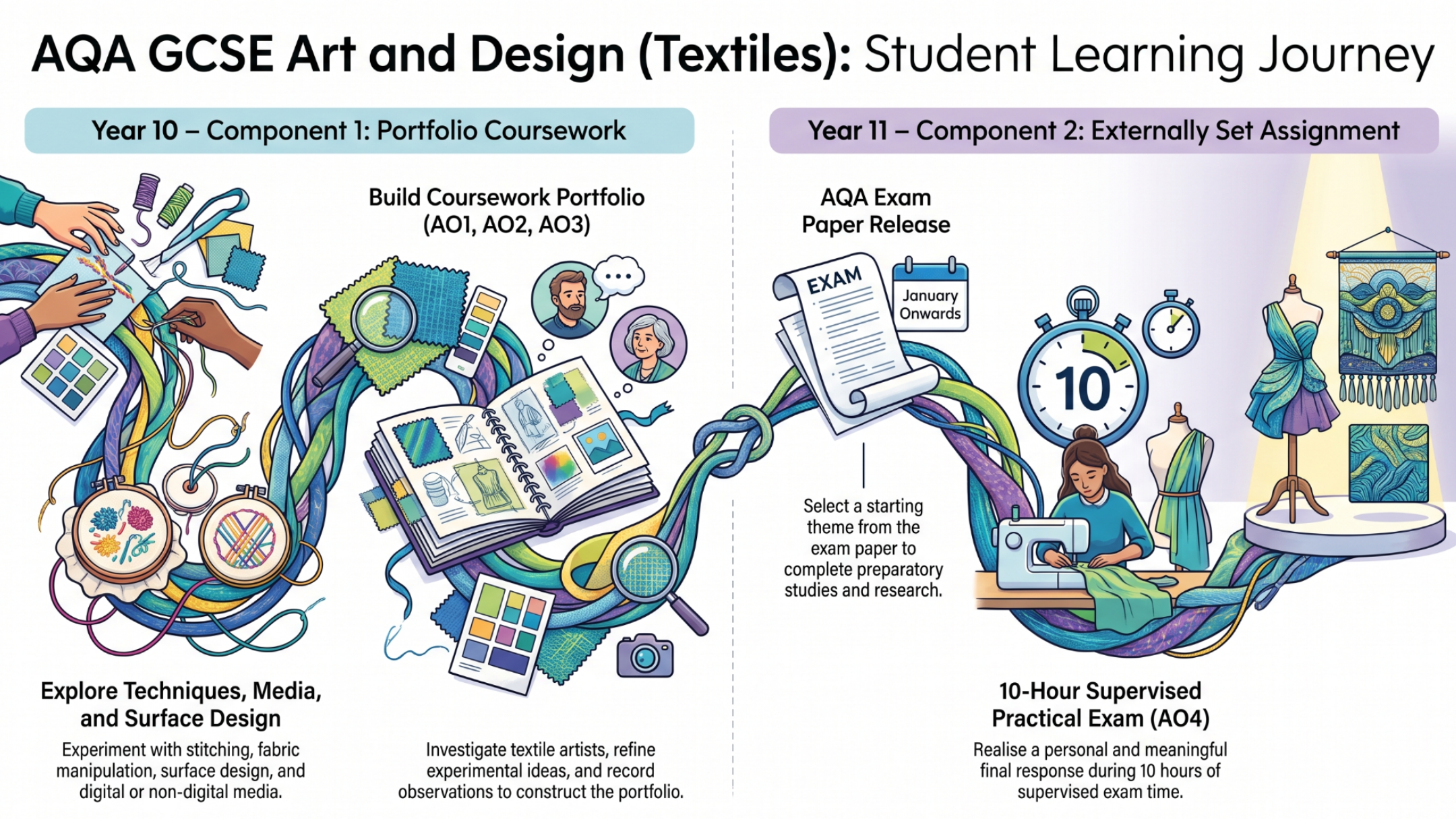
KS4: AQA GCSE Art and Design (Textiles)
The GCSE Textiles curriculum is a linear, two-year course that blends practical craftsmanship with critical and contextual study, encouraging students to express personal ideas through tactile and visual media. Learning is driven by four core Assessment Objectives (AO1–AO4):
Component 1: Portfolio (Coursework, 60%): Students build a comprehensive portfolio demonstrating creative investigations, critical analysis of textile artists, and open experimentation with media, materials, and processes. Work can encompass two-dimensional, three-dimensional, digital, or non-digital formats, incorporating stitching, fabric manipulation, printing, embellishment, and surface design.
Component 2: Externally Set Assignment (40%): Learners respond to an externally set theme, undertaking a period of preparatory research and experimentation before realizing an authentic final outcome during supervised time.
Core Competencies Developed:
AO1: Investigating ideas and demonstrating critical understanding of sources.
AO2: Refining work through creative media experimentation and process mastery.
AO3: Recording ideas, observations, and insights through annotation, drawing, and visual language.
AO4: Presenting a personal, meaningful response that realizes original intentions with confidence.
This qualification fosters creative autonomy and discrimination, preparing learners for further study in A-Level Art and Design, fashion, textiles, or visual arts industries.
Hair & Beauty:
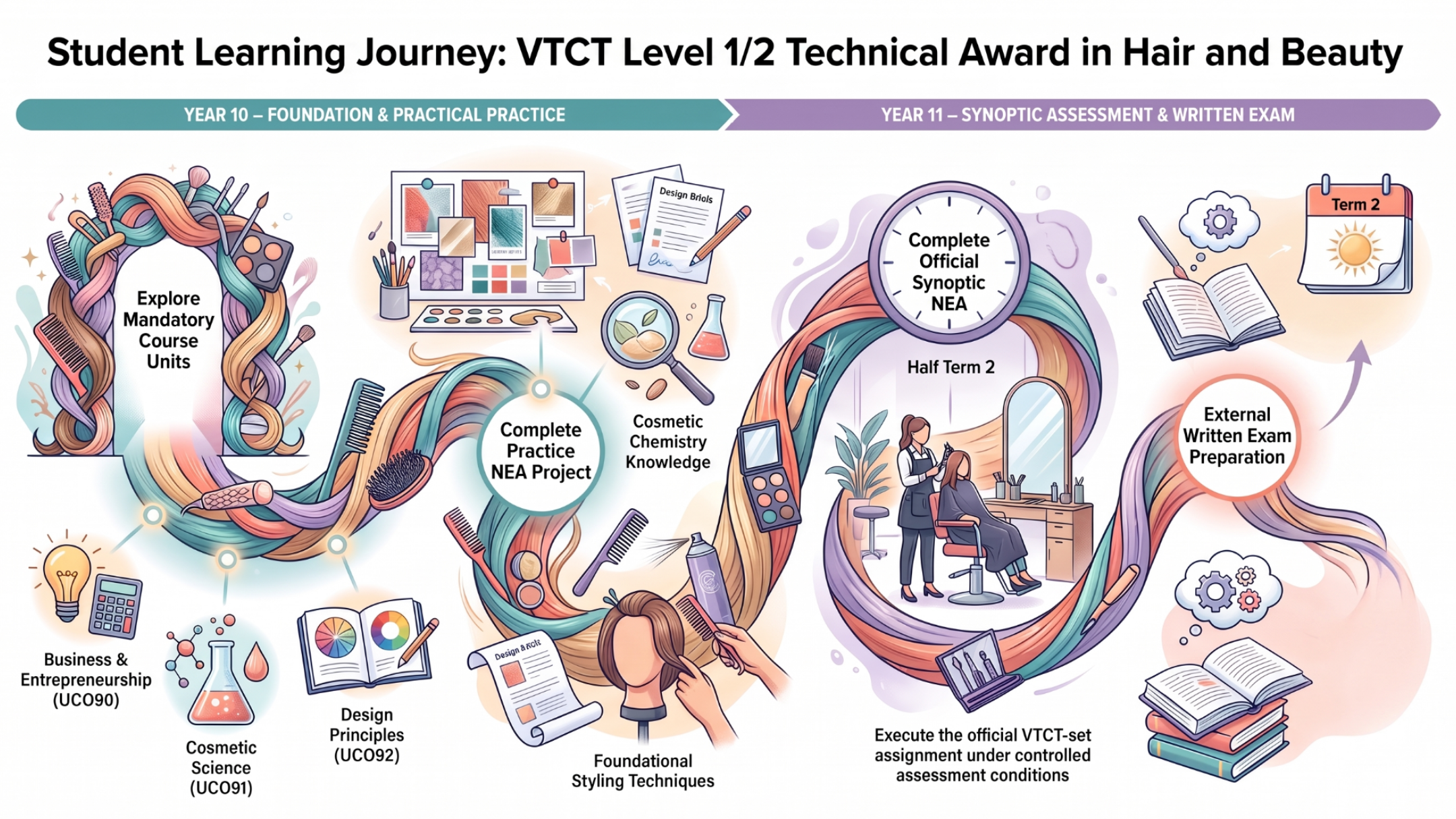
KS4: VTCT Level 1/2 Technical Award in the Study of Hair and Beauty
The Hair and Beauty curriculum offers an engaging, applied science and business education, exploring the multi-billion-pound personal care sector through practical styling, scientific investigation, and commercial enterprise. The course comprises three core areas evaluated via an external exam and a synoptic non-exam assignment:
Business and Entrepreneurship in the Hair and Beauty Sector (UCO90): Learners investigate salon structures, market opportunities, financial planning, customer service standards, environmental sustainability, and the 4 Ps of marketing (Product, Price, Place, Promotion) alongside legal and hygiene regulations.
Anatomy, Physiology and Cosmetic Science (UCO91): Students study cosmetic chemistry, ingredient functions, and the structure and health of the integumentary system (skin, hair, and nails). Learners explore cosmetic formulation, product safety, and the full development lifecycle from initial concept to commercial launch.
Design in the Hair and Beauty Sector (UCO92): Combining artistic flair with problem-solving, students work to client briefs, conducting primary and secondary research to design holistic image transformations. Learners present creative styling concepts incorporating hair, makeup, prosthetics, body art, and mood boards, using reflective practice (SWOT analysis) to evaluate their work.
This qualification equips students with rigorous technical knowledge and creative styling skills, laying a solid foundation for post-16 Level 3 qualifications, specialist aesthetics training, or salon apprenticeships.